1. The Modern Macro-Crisis: The “Standard Height” Fallacy
In 2026, we are witnessing a systemic failure in office furniture manufacturing: the Standard Height Fallacy. For decades, the industry-standard desk height has been fixed at 29 to 30 inches. This measurement was derived from the 50th percentile of the mid-20th-century male workforce. Today, this arbitrary “standard” is failing over 70% of high-performers.
The result is a macro-crisis of Digital Overuse Syndrome. When a desk is even 1 inch too high, the body compensates by shrugging the shoulders—a state of Chronic Trapezius Loading. When it is too low, the user enters a “C-Curve” spinal collapse. In an era where 14-hour workdays are common in elite tech and finance hubs, these micro-misalignments compound into macro-disabilities. The status quo is no longer an inconvenience; it is a drain on Human Capital.
2. The Scientific & Biomechanical Foundation: The Kinetic Triangle
To find your “Perfect Fit,” we must analyze the interaction between the Cervical Spine, the Glenohumeral Joint (Shoulder), and the Carpal Tunnel through the lens of mechanical leverage.
The 90-Degree Myth vs. The 105-Degree Reality
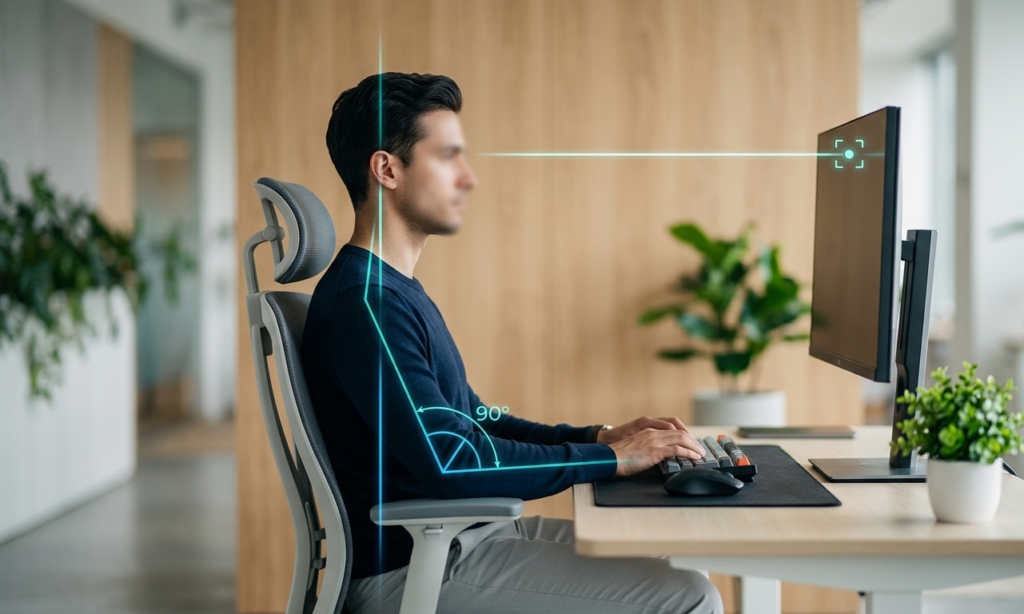
Legacy ergonomics taught the “90-degree rule” for elbows. In 2026, biomechanical research has evolved. A 90-degree angle actually puts the Ulnar Nerve under slight tension. The “Smart” fit is a 100 to 105-degree open angle at the elbow. This minimizes Intracarpal Pressure and prevents the shortening of the bicep tendon, which can lead to “Mouse Elbow.”
The Physics of Ocular Strain and Cervical Load
Your desk height is the “anchor” for your monitor height. The Frankfort Plane (the line from the ear canal to the bottom of the eye socket) should be parallel to the floor. If your desk is too high, your shoulders rise, your neck retracts, and you develop Upper Cross Syndrome. This creates a Moment Arm at the base of the skull. For every inch your head tilts forward, the effective weight on your spine increases by 10 lbs. A desk height error of just 2 inches can effectively double the weight of your head, leading to tension-type headaches that sabotage C-Suite decision-making.
Kinetic Chain Grounding
Proper height starts at the feet. If your desk is too high, you likely raise your chair to match it, leaving your feet dangling or “perched.” This cuts off circulation at the Popliteal Fossa (back of the knee) and places the Sciatic Nerve under compression. The height of the desk must be the final variable in a sequence that begins with Plantar Grounding.
3. The Tiered Market Solution: 2026 Height Optimization
We have audited the 2026 hardware landscape to provide solutions for achieving these precise metrics.
Tier 1: The Essential Entry-Point (The Retrofit)
For those with fixed-height desks, the solution is “Vertical Shifting” using external peripherals.
The Benchmark: HUANUO Adjustable Monitor Stand
By decoupling the monitor height from the desk surface, you can correct the ocular plane even if the desk surface is sub-optimal.
- Technical Specs: * Height Range: 3.5″ to 6″.
- Capacity: 44 lbs.
- Features: Built-in drawer for “Zero-Clutter” desktop.
- Pros: Extremely cost-effective; allows for “Standard” desks to accommodate taller users.
- Cons: Does not solve the elbow-angle issue for shorter users.
| Metric | HUANUO Stand |
| Adjustment Increments | 3-Stage |
| Material | Reinforced Steel/ABS |
| Primary Fix | Cervical Realignment |
Tier 2: The Mid-Range Performance Standard (The Electric Pivot)
The “Sweet Spot” for 2026 professionals is the dual-motor sit-stand desk that allows for millimeter-precise presets.
The Benchmark: FLEXISPOT E7 Pro
The E7 Pro is the 2026 standard for stability, utilizing a thickened C-frame to eliminate “monitor wobble” at maximum extension.
- Technical Specs: * Height Range: 25″ to 50.6″.
- Travel Speed: 1.5 in/s.
- Weight Capacity: 440 lbs.
- Pros: Accommodates 99% of the population; 4-position memory controller for “Sit, Stand, Perch, and Collab.”
- Cons: Requires a power source; assembly takes approximately 45 minutes.
| Metric | FLEXISPOT E7 Pro |
| Motor Type | Dual-Motor High-Torque |
| Stability Rating | 9/10 (Elite) |
| Primary Fix | Dynamic Kinetic Loading |
Tier 3: The Elite/Enterprise Grade (The Bio-Responsive Workspace)
At this level, the desk is an integrated piece of robotics that adjusts to the user’s specific anthropometry automatically.
The Benchmark: Uplift V2-Commercial
The 2026 Commercial model is the only desk featuring a crossbar for high-lateral stability while maintaining a lower minimum height for smaller-framed executives.
- Technical Specs: * Height Range: 22.6″ to 48.7″.
- Controller: AI-Integration for “Movement Reminders.”
- Warranty: 15-Year Enterprise Grade.
- Pros: The widest height range on the market; accommodates those who are 5’0″ as easily as those 6’6″.
- Cons: Significant investment; requires a dedicated circuit if using integrated power strips.
| Metric | Uplift V2-Commercial |
| Adjustment Range | 26.1″ (Industry Leading) |
| Frame Stability | Crossbar Reinforced |
| Primary Fix | Total Anthropometric Inclusion |
4. Advanced “Zero-Cost” Optimization & Physics
If you cannot change your desk, use the “Book-Stack” Calibration:
- The Elbow Anchor: Sit in your chair with shoulders relaxed. Measure from the floor to the bottom of your elbow. This is your Ideal Surface Height. If your desk is higher than this, you must raise your chair and use a footrest. A stack of old manuals can serve as a temporary footrest to ensure your knees stay at 90° and your lower back remains in the Neutral Zone.
- The Phone Leveler: Use your smartphone’s “Level” app. Place it on your forearm while typing. If the angle is >5° (upward), you are at high risk for Carpal Tunnel. Adjust your chair or desk until the level reads 0° to -5°.
5. Environmental Synergy & Cognitive Load
Desk height directly impacts Respiratory Efficiency. When you slouch due to a low desk, you compress the Diaphragm. This leads to shallow “Chest Breathing,” which triggers the brain’s “Alert” state, increasing anxiety and lowering the threshold for stress. By raising your workspace to a “Simple & Smart” height, you open the thoracic cavity, allowing for Diaphragmatic Breathing. This oxygenates the blood more efficiently, lowering your heart rate and allowing for extended periods of High-Output Cognitive Work.
6. The “Executive Audit”
Perform this 10-second check now:
- Shoulders: Are they near your ears? (Desk is too high).
- Wrists: Are they bent upward to reach the keys? (Desk is too high).
- Eyes: Are you looking down at the screen? (Monitor is too low).
Feet: Are they flat on the floor? (If not, your chair is too high for your desk).