1. The Modern Macro-Crisis: The “Screen-Stare” Epidemic
In the current professional landscape, the human visual system is under an unprecedented biological assault. The shift to high-density, multi-screen environments—often spanning 10 to 14-hour “crunch” shifts—has outpaced our evolutionary design. We are utilizing a visual apparatus evolved for long-range predatory tracking and foraging to perform high-frequency, short-range data processing.
The “status quo” of “just taking a break” is a failure of professional discipline. High-performers ignore early warning signs—photophobia, burning sensations, and intermittent blurred vision—viewing them as a cost of doing business. This neglect leads to a measurable decay in Cognitive Endurance. When the brain must work harder to resolve blurred text or manage Binocular Disparity, it siphons glucose and neural energy away from high-level decision-making. We are witnessing a crisis of “Visual Burnout” that directly correlates with reduced billable efficiency and increased error rates in data-intensive sectors.
2. The Scientific & Biomechanical Foundation: The Anatomy of Fatigue
To solve eye strain, one must understand the Muscular Micro-Physics of the eye.
Ciliary Muscle Spasm and Accommodation stress
The human eye focuses via the Ciliary Muscle, which changes the shape of the lens. When staring at a fixed distance (the screen) for hours, this muscle enters a state of Tonic Contraction. Like holding a 10 lb dumbbell at a 90-degree angle, the muscle eventually spasms. This is known as Accommodative Lag. The physics of this constant near-point stress results in a breakdown of the Vergence-Accommodation Coupled System, making it physically difficult to refocus on distant objects.
The Tear Film Dynamics and Blink Rate Suppression
Biologically, humans blink approximately 15–20 times per minute. However, during “High-Cognitive Load” tasks, the Blink Rate drops by a staggering 60% to 70%. This causes an immediate rupture in the Pre-corneal Tear Film. The result is localized Corneal Desiccation (dry spots), which increases light scattering and forces the brain to work harder to “denoise” the incoming visual signal.
Blue Light and High-Energy Visible (HEV) Radiation
At a physics level, short-wavelength blue light (400-450nm) scatters more easily than longer wavelengths. This creates “visual noise” that reduces Image Contrast. The eye’s struggle to maintain contrast sensitivity leads to Ocular Hypertension and interferes with the Circadian Entrainment of the master clock (the Suprachiasmatic Nucleus), ruining sleep quality long after the shift ends.
3. The Tiered Market Solution: Visual Optimization
Tier 1: The Essential Entry-Point (The High-ROI Foundation)
Focus on immediate moisture retention and wavelength filtration.
- Primary Shield: Blue Light Blocking Glasses
- Hydration: Preservative-Free Lubricating Eye Drops
- Utility: Anti-Glare Screen Filter
| Technical Spec | Requirement |
| Blue Light Cut | 90% at 410nm |
| Viscosity | Low (Daytime use) |
| Coating | Matte (AG) |
Pros: Immediate reduction in “digital grit” sensation; low barrier to entry.
Cons: Drops provide temporary relief only; glasses can cause “nose-bridge fatigue” over 12 hours.
Tier 2: The Mid-Range Performance Standard (The Professional Sweet Spot)
Engineering the environment to match the physiological needs of the eye.
- Primary Lighting: BenQ ScreenBar Monitor Light
- Correction: Computer Reading Glasses (+0.5 to +0.75)
- Environment: Desk Humidifier
| Technical Spec | Requirement |
| Color Rendering Index (CRI) | >95 Ra |
| Auto-Dimming | Integrated Sensor |
| Mist Output | 30-50 ml/h |
Pros: Eliminates screen glare; reduces the “accommodation load” via slight magnification; stabilizes the tear film.
Cons: Requires dedicated desk real estate; humidifier requires daily maintenance to prevent microbial growth.
Tier 3: The Elite/Enterprise Grade (Maximum Longevity)
The high-authority setup for executives who cannot afford a single minute of visual downtime.
- Display Tech: E-Ink Secondary Monitor
- Primary Display: 4K IPS Low-Blue-Light Monitor (TÜV Certified)
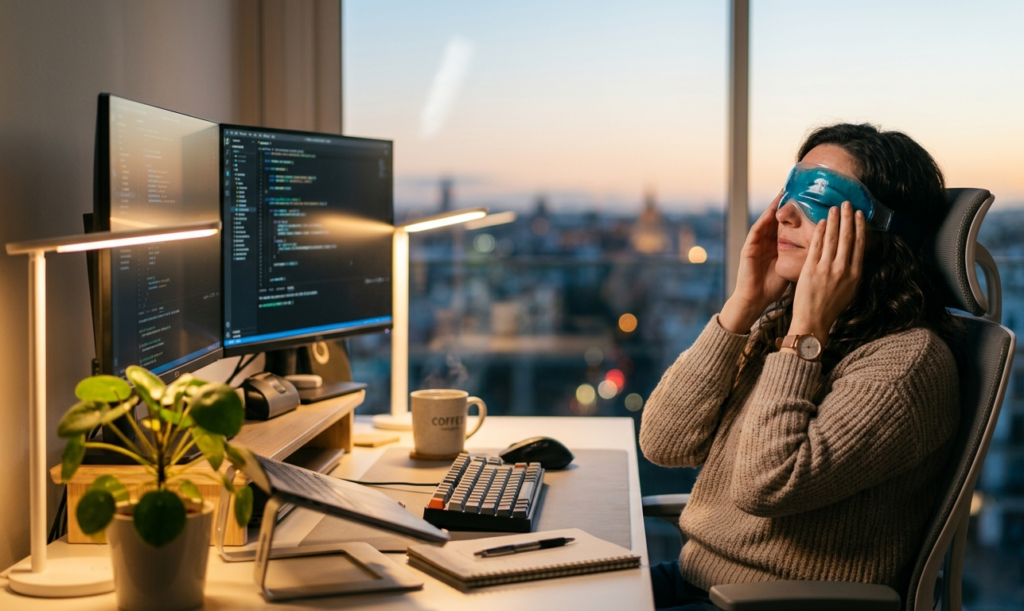
- Advanced Relief: Therapeutic Heated Eye Mask
| Technical Spec | Requirement |
| Certification | TÜV Rheinland Eye Comfort |
| Refresh Rate | 120Hz+ (reduces flicker) |
| Heat Range | 104°F – 113°F (Imperial) |
Pros: E-ink provides zero-emit reflective light for reading documents; heated masks liquefy Meibomian Gland lipids to fix dry eyes permanently.
Cons: E-ink has high latency (not for video); significant hardware investment.
4. Advanced “Zero-Cost” Optimization & Physics
The most powerful tool in your arsenal is the 20-20-20 Rule, but we will enhance it with Far-Point Fixation. Every 20 minutes, look at an object at least 20 feet away for 20 seconds. This forces the Ciliary Muscle into Complete Relaxation.
Furthermore, apply the Harmonious Contrast Rule: your screen brightness should never be higher than the ambient light behind it. If you work in a dark room with a bright screen, the Pupillary Sphincter muscle is caught in a “Physical Conflict”—trying to dilate for the room while constricting for the screen. Match your “Nits” (brightness) to your “Lux” (surroundings).
5. Environmental Synergy & Cognitive Load
Visual clutter is not just an aesthetic issue; it is a Peripheral Distraction issue. The human eye has a wide field of view. High-contrast objects in your periphery trigger the Superior Colliculus, causing micro-saccades (tiny eye movements) that you aren’t even aware of. By clearing your peripheral workspace, you reduce the “Neural Noise” your brain has to filter, effectively lowering your Cognitive Load and extending your shift endurance.
6. The “Executive Audit”
- [ ] Monitor Distance: Is the screen 20–30 inches (arm’s length) away?
- [ ] Gaze Angle: Is the center of the screen 15–20 degrees below eye level?
- [ ] Glow Check: Is there a visible reflection on the screen from windows or lamps?
- [ ] Air Flow: Is an AC vent blowing directly into your face (accelerating evaporation)?