1. The Modern Macro-Crisis: The Collapse of the Circadian Standard
In 2026, the boundary between the professional “workspace” and the “rest-space” has not merely blurred; it has been vaporized by a hyper-dynamic digital infrastructure. The average executive now interfaces with high-luminance OLED and MicroLED displays for upwards of 10.5 hours daily. This transition to an all-digital professional existence has birthed a silent, systemic macro-crisis: the Circadian Desynchrony Pandemic.
The “status quo”—relying on software-based night modes or generic drugstore “blue blockers”—is failing the high-performer. Software filters, while convenient, do not address ambient light pollution or the high-energy visible (HEV) light leaking from peripheral environments. Socio-economic pressures demand 24/7 responsiveness, yet our biological hardware remains tethered to a prehistoric Light-Dark Cycle. When we force a 21st-century cognitive load onto an 18th-century sleep-wake system, the result is a catastrophic drop in neuroplasticity, executive function, and metabolic health. We are currently witnessing a generational rise in digital ocular fatigue and melatonin suppression, costing the global economy billions in lost productivity. To survive this landscape, the modern professional must treat their “spectral diet” with the same precision as their caloric intake.
2. The Scientific & Biomechanical Foundation: The Physics of Phototoxicity
To understand the necessity of elite-grade 2026 eyewear, one must move beyond the marketing fluff and into the biophysics of the retina. The human eye is not merely a camera; it is a complex hormonal regulator.
The ipRGC Pathway and Melanopsin Activation
The primary driver of circadian entrainment is the Intrinsically Photosensitive Retinal Ganglion Cell (ipRGC). These cells contain melanopsin, a photopigment specifically sensitive to the 460–480 nm range of the blue light spectrum. When HEV light hits these cells, they send a signal through the Retinohypothalamic Tract directly to the Suprachiasmatic Nucleus (SCN)—the master clock of the brain. This signal suppresses the pineal gland’s production of melatonin, the hormone responsible for initiating the systemic repair state known as sleep.
Phototoxicity and Retinal Oxidative Stress
Beyond sleep, the physics of blue light concerns photon energy. Short-wavelength light (380–450 nm) carries higher energy than long-wavelength red light. This energy penetrates the cornea and lens, reaching the Retinal Pigment Epithelium (RPE). In 2026, clinical research has solidified the link between chronic HEV exposure and the production of Reactive Oxygen Species (ROS) within the mitochondria of retinal cells. This leads to Lipofuscin accumulation, a precursor to Age-Related Macular Degeneration (AMD).
From a biomechanical perspective, the eye’s musculature—the ciliary muscles and extraocular muscles—undergoes constant micro-oscillations to process the flickering of LED backlights. This creates a state of Kinetic Chain Fatigue, where the tension in the ocular muscles radiates to the occipital nerves, manifesting as “tech-neck” and tension headaches. Elite blue light glasses act as a mechanical shield, reducing the refractive index stress on the lens and allowing the ciliary body to maintain a state of “rested focus.”
3. The Tiered Market Solution: 2026 Marketplace Analysis
Tier 1: The Essential Entry-Point (ROI-Focused)
For the professional beginning their ergonomic journey, the goal is glare reduction and contrast enhancement without a prohibitive investment.
- Top Pick: Peepers Clark Focus
- Technical Specs: * Blue Light Block: 40% (400–450 nm)
- Lens Coating: 7-layer Anti-Reflective (AR)
- Frame Material: Lightweight Polycarbonate
- Pros: Exceptional value; includes +0.00 to +3.00 magnification options; stylish enough for public use.
- Cons: Limited protection for late-night “Melatonin-Shielding” sessions; higher color distortion than Tier 3.
Tier 2: The Mid-Range Performance Standard (Professional Grade)
The “sweet spot” for 8-hour daily use. These frames focus on color accuracy—essential for developers, designers, and analysts.
- Top Pick: Gunnar Vertex Clear
- Technical Specs:
- Blue Light Block: 35% (Gunnar G-Shield Technology)
- Lens Tint: “Clear” (Minimal color shift)
- Design: Ergonomic wide-format for peripheral coverage
- Pros: Patented lens geometry reduces Digital Dry Eye; high build quality for 2026 standards.
- Cons: The “Clear” lens does not block enough blue light for use 2 hours before bed.
Tier 3: The Elite/Enterprise Grade (Maximum Longevity)
No compromises. These are medical-grade tools designed for the “Spectral Athlete” who works late into the night.
- Top Pick: Felix Gray Roebling Amber
- Technical Specs:
- Blue Light Block: 50% HEV / 90% in the 400–440 nm range.
- Lens Material: Proprietary Ophthalmic-grade polymer
- Hinge System: Laser-welded Italian Acetate
- Pros: Maximum melatonin protection; virtually zero glare; industry-leading Optical Clarity Index.
- Cons: High initial cost; amber tint slightly alters color perception (not for color-grading work).
| Feature | Tier 1 (Peepers) | Tier 2 (Gunnar) | Tier 3 (Felix Gray) |
| HEV Blocking | 40% | 35% | 50%+ |
| Melatonin Support | Low | Medium | High |
| Frame Durability | Moderate | High | Enterprise-Grade |
| Price Range | $25–$35 | $50–$80 | $95–$150+ |
4. Advanced “Zero-Cost” Optimization & Physics
You cannot buy your way out of poor habits. To augment your eyewear, apply the Inverse Square Law of Physics: doubling your distance from a screen reduces the intensity of light by 75%.
- The 20-20-20 Hack: Every 20 minutes, look at an object 20 feet away for 20 seconds. This releases the ciliary muscle lock, preventing Accommodative Spasm.
- The Saccadic Reset: Periodically close your eyes and perform “Figure-8” rolls. This distributes tear film and resets the Proprioceptive sensors of the eye, reducing the cognitive load of tracking high-refresh-rate cursors.
5. Environmental Synergy & Cognitive Load
Blue light doesn’t act in a vacuum. High Cognitive Load is exacerbated by poor Acoustic Dampening and Air Quality. In a carbon-rich (CO2 > 1000ppm) office, your eyes become more sensitive to glare due to reduced blood oxygenation. Synergizing your glasses with a 6500K “Daylight” LED during the day and 2700K “Warm” light at night creates a Hormonal Buffer, ensuring your cortisol levels remain high during focus hours and drop off naturally for recovery.
6. The “Executive Audit”
- Verify Lens Spectrum: Does your provider offer a spectral transmission report?
- Check Fit: Are the frames resting on the bridge of the nose without temporal compression?
- Lighting Check: Is your monitor the brightest object in the room? (It shouldn’t be).
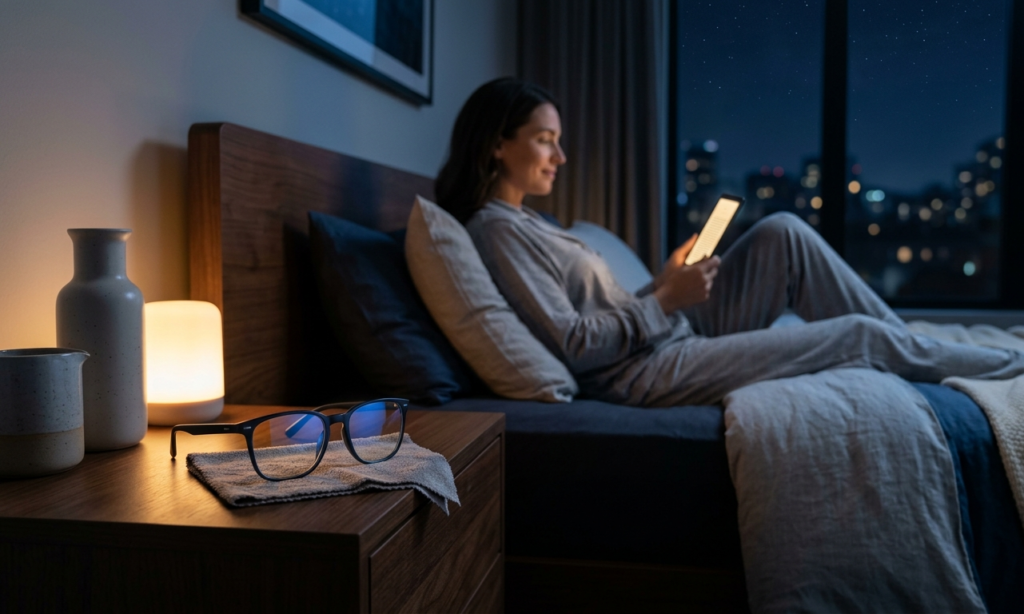
- Evening Protocol: Swap to Amber lenses 120 minutes before planned sleep.