
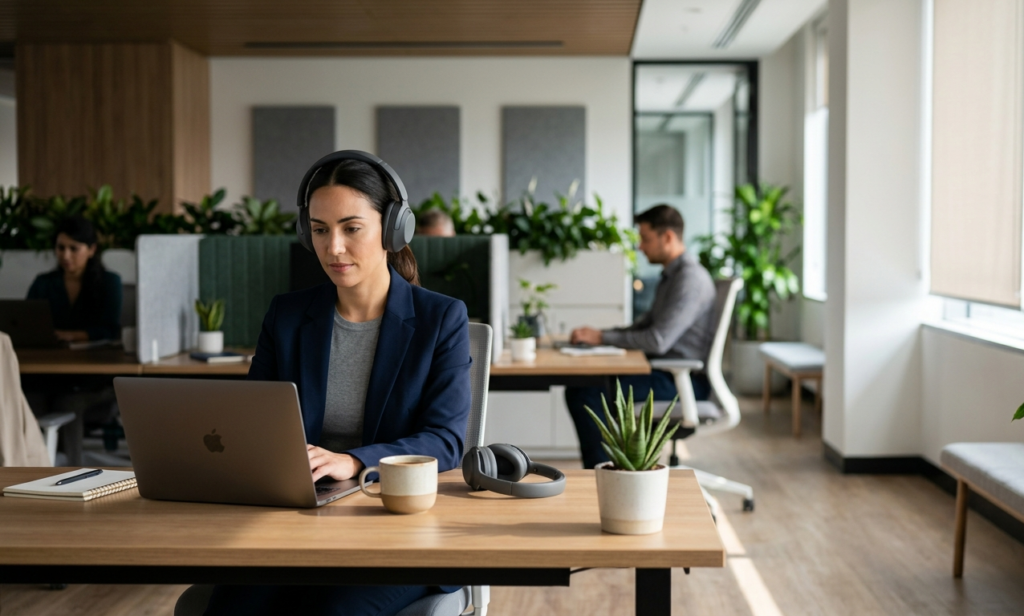
1. The Modern Macro-Crisis: The Death of Deep Work
The “open office” experiment of the early 21st century has reached its inevitable, systemic failure. What was marketed as a “collaboration-rich” landscape has mutated into a high-decibel arena of cognitive fragmentation. In 2026, the professional landscape is defined by a paradox: we are more connected than ever, yet our ability to achieve Deep Work is at an all-time nadir.
The macro-crisis is not merely one of “noise”; it is a crisis of Biological Interference. High-performers in 2026 are forced to navigate environments where the ambient sound floor regularly exceeds 65 decibels (dB)—a level scientifically proven to disrupt linguistic processing and elevate cortisol. The socio-economic pressure to produce “at pace” in shared environments (coworking hubs, hybrid HQs, and boutique studios) has turned silence into a luxury commodity. The status quo—relying on “polite” social cues or subpar foam earplugs—is failing the modern executive. To survive this landscape, the professional must architect their own auditory environment. We are no longer just choosing “headphones”; we are selecting a Cognitive Shield.
2. The Scientific & Biomechanical Foundation: Neural Compression & Kinetic Focus
To understand why the right headset is critical, one must move beyond “loudness” and into the Biomechanical impact of sound.
The Mechanism of Neural Compression
Human hearing is not a passive system; it is an active, anticipatory filtering mechanism. When you work in a shared office, your Primary Auditory Cortex is under constant siege. The brain must perform a process known as Auditory Scene Analysis (ASA). In a noisy office, the brain’s Prefrontal Cortex—the seat of executive function—must expend significant glucose-driven energy to “inhibit” irrelevant stimuli (the coffee grinder, the sales call three desks over). This constant suppression creates Neural Fatigue, leading to a measurable decline in decision-making quality by mid-afternoon.
Active Noise Cancellation (ANC) Physics
Modern ANC works on the principle of Destructive Interference. Integrated microphones sample the external waveform and generate an “anti-noise” signal—a wave with the exact same amplitude but inverted phase ($180^\circ$ out of phase). When these waves meet, they cancel out, effectively flattening the pressure wave before it reaches the tympanic membrane.
However, in 2026, the frontier is no longer just about volume reduction. It is about Non-Stationary Noise Suppression. Legacy ANC struggled with “unpredictable” sounds (a falling pen, a sudden laugh). The 2026 elite class of hardware utilizes Edge-AI Processing to predict these transient spikes.
The Biomechanical Loop
Furthermore, noise triggers a Sympathetic Nervous System response. Chronic exposure to “irrelevant speech” (the most distracting noise type in offices) stimulates the HPA (Hypothalamic-Pituitary-Adrenal) Axis, resulting in elevated Cortisol and Adrenaline. This isn’t just “annoying”—it is a physical stressor that increases heart rate variability (HRV) and muscle tension along the Kinetic Chain, specifically in the cervical spine (neck) and trapezius, as the body subconsciously “braces” for impact.
3. The Tiered Market Solution: 2026 Enterprise Analysis
We have audited the 2026 marketplace to provide a tripartite analysis based on ROI, performance, and professional longevity.
Tier 1: The Essential Entry-Point (The High-ROI Solution)
For professionals entering the hybrid space, the focus is on “Minimum Viable Silence”—the highest possible noise reduction for the lowest capital outlay.
The Benchmark: Sony WH-CH720N
While an older architecture, the 2026 firmware updates have kept this model relevant for budget-conscious professionals who prioritize battery life over premium materials.
- Technical Specs: * Weight: 6.8 oz.
- Battery: 50 Hours (ANC On).
- Processor: Integrated Processor V1.
- Pros: Exceptional weight-to-performance ratio; “all-day” battery removes charging anxiety.
- Cons: Plastic chassis lacks “Executive” aesthetic; passive isolation is weak without ANC active.
| Comparison Metric | Sony WH-CH720N |
| Noise Reduction Rating (NRR) | ~22dB |
| Microphone Type | Dual Beamforming |
| Comfort Rating | 7/10 |
Tier 2: The Mid-Range Performance Standard (The Sweet Spot)
This tier represents the “Standard Issue” for 2026 high-performers. These devices balance acoustic transparency, multipoint connectivity, and superior ANC.
The Benchmark: Bose QuietComfort Ultra (2nd Gen)
Bose’s 2026 refresh focuses on CustomTune technology, which calibrates the sound and ANC specifically to the internal geometry of the user’s ear canal.
- Technical Specs: * Weight: 8.9 oz.
- ANC Modes: Quiet, Aware, and Immersion (Spatial).
- Connectivity: Bluetooth 5.4 with aptX Adaptive.
- Pros: Best-in-class comfort for 8+ hour shifts; revolutionary “Immersive Audio” reduces listener fatigue.
- Cons: Multipoint switching can occasionally lag in high-interference environments.
| Comparison Metric | Bose QC Ultra (2nd Gen) |
| Noise Reduction Rating (NRR) | ~30dB |
| Microphone Type | 12-Mic Array (AI-Isolated) |
| Comfort Rating | 10/10 |
Tier 3: The Elite/Enterprise Grade (Maximum Longevity)
At this level, the headphone is a piece of Bio-Sensing Equipment. These are for the C-Suite and elite consultants where a single hour of lost focus equals thousands in lost revenue.
The Benchmark: Sony WH-1000XM6
The XM6 (Released mid-2025) is the 2026 gold standard. It utilizes a dual-processor architecture (V3 and QN2) and Bone Conduction Sensors for call clarity.
- Technical Specs: * Weight: 8.8 oz.
- Frequency Response: 4Hz – 40,000Hz (Hi-Res).
- Sensors: Proximity, Bone Conduction, Atmospheric Pressure.
- Pros: Unrivaled suppression of human speech frequencies; “Speak-to-Chat” automation is flawless.
- Cons: Case remains bulky; high price point.
| Comparison Metric | Sony WH-1000XM6 |
| Noise Reduction Rating (NRR) | ~34dB (Adaptive) |
| Microphone Type | AI-Enhanced Beamforming + Bone Conduction |
| Comfort Rating | 9/10 |
4. Advanced “Zero-Cost” Optimization & Physics
If your hardware is currently limited, you can utilize Acoustic Shadowing and Bio-Feedback to mitigate stress.
- The Corner-Loading Effect: By positioning your desk in a corner, you create an acoustic trap. However, ensure you are facing away from the corner. Sound waves bouncing off the walls behind you are easier for ANC to cancel than direct-line speech from the front.
- The Pink Noise Supplement: If your ANC is struggling with high-pitched voices, play “Pink Noise” at a low volume. Unlike White Noise, Pink Noise has equal energy per octave, mirroring the $1/f$ Power Spectrum of the human brain’s resting state, which masks distracting frequencies without adding significant cognitive load.
5. Environmental Synergy & Cognitive Load
Your headphones do not exist in a vacuum. Visual Clutter acts as “optical noise,” which compounds with auditory noise to overload the Ventrolateral Prefrontal Cortex. In a shared office, use a minimalist desk setup to lower your total sensory input. Pairing high-end ANC with Circadian Lighting (6500K for focus, 2700K for winding down) ensures that your internal biological clock remains synced even when the external office environment is chaotic.
6. The “Executive Audit”
Verify your auditory health with this rapid checklist:
- Is the ANC adaptive? (Does it adjust as people enter/exit the room?)
- Is the clamping force under 1.2 lbs? (Prevents tension headaches).
- Does it support Multipoint? (Laptop and Phone simultaneously).
- Is the mic AI-isolated? (Ensures your colleagues only hear you, not the background).