1. The Modern Macro-Crisis: The Failure of the “Static Stand”
In 2026, the global workforce has largely transitioned to the “Active Workstation” model. However, a new macro-crisis has emerged: The Static Standing Epidemic. While the shift away from sedentary behavior was a necessary victory for public health, it introduced a secondary failure point. High-performers, eager to escape the metabolic hazards of sitting, have traded lumbar compression for Venous Pooling and Lower Limb Ischemia.
The “status quo” of standing directly on commercial-grade carpet or hardwood for 4–6 hours a day is failing. In the US, musculoskeletal disorders (MSDs) related to improper standing posture have risen by 12% since 2023. This is not a failure of the standing desk itself, but a failure of the Interface. Without a dynamic surface, the body becomes a rigid pillar, leading to “Sledgehammer Fatigue”—the sensation of heavy, leaden legs that kills afternoon cognitive output. To maintain elite performance, the floor can no longer be a passive element; it must be an engineered ergonomic component.
2. The Scientific & Biomechanical Foundation: The Physics of “Micro-Oscillation”
To answer “Do you need a mat?”, one must look at the Kinetic Chain through the lens of physics and fluid dynamics.
The Venous Pump & Muscle-Skeletal Interaction
The human body is not designed for static verticality. Unlike the arterial system, which is pressurized by the heart, the venous system in the lower extremities relies on the Musculovenous Pump. As you stand, gravity pulls blood toward your feet. To return this blood to the heart against gravity, the calf muscles (gastrocnemius and soleus) must contract to squeeze the veins.
On a hard surface, your muscles reach a state of Tetanic Contraction—a low-level, constant state of tension to maintain balance. This static contraction actually constricts blood flow, leading to Edema (swelling) and the buildup of metabolic waste like lactic acid.
Micro-Oscillations and Proprioception
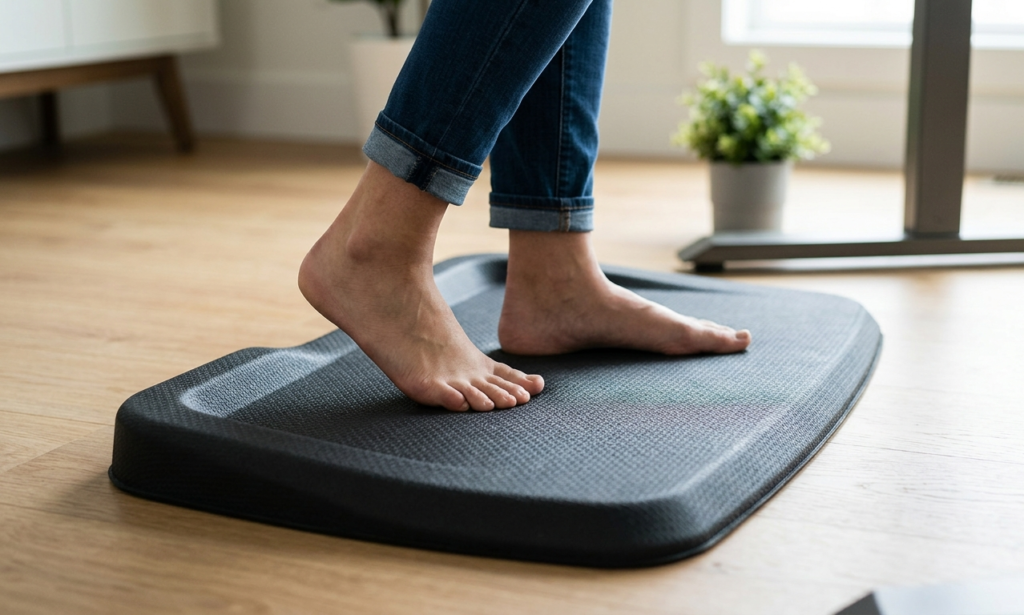
An anti-fatigue mat introduces a specific level of Instability. This is not the dramatic instability of a balance board, but a subtle, subconscious “give.” This triggers Proprioception—your brain’s sense of self-movement and body position.
When the surface beneath you is slightly yielding, your intrinsic foot muscles and calves engage in constant, nearly invisible Micro-Oscillations. These movements act as a secondary heart, continuously pumping blood back up the legs. Furthermore, a mat reduces the Ground Reaction Force (GRF). Standing on a hard floor reflects approximately 100% of your body weight back into your calcaneus (heel bone), vibrating up through the kinetic chain to the lumbar spine. An engineered 2026 polyurethane mat can reduce this peak pressure by up to 40%, distributing the load across the entire plantar surface of the foot.
Circadian Entrainment & Cortisol
The physical discomfort of standing on a hard floor triggers a systemic stress response. Chronic “foot-pain distraction” increases Cognitive Load, diverting neural resources from the Prefrontal Cortex to the Somatosensory Cortex. This elevated stress profile disrupts Circadian Entrainment; if your body is in a state of high-cortisol “fight or flight” due to physical pain at 3:00 PM, your ability to transition into deep sleep at 10:00 PM is compromised.
3. The Tiered Market Solution: 2026 Professional Audit
We have categorized the 2026 mat market into three tiers of intervention.
Tier 1: The Essential Entry-Point (ROI-Focused)
For those who stand 1–2 hours daily, a flat, high-density foam mat is the baseline for preventing immediate joint inflammation.
The Benchmark: Amazon Basics Anti-Fatigue Mat
The 2026 iteration features a reinforced beveled edge to prevent curling and trip hazards in high-traffic home offices.
- Technical Specs: * Thickness: 0.75 inches.
- Material: NBR (Nitrile Butadiene Rubber) / PVC Blend.
- Surface: Non-slip, textured.
- Pros: Extremely cost-effective; fits under any standard desk; easy to clean.
- Cons: “Bottoms out” for users over 220 lbs; lacks topographical features for active movement.
| Metric | Amazon Basics (2026) |
| Compression Set | < 10% |
| Durability Rating | 3/5 Years |
| Primary Use | Home Office / Light Standing |
Tier 2: The Mid-Range Performance Standard (The Professional’s Choice)
This tier introduces Topographical Design, allowing for stretching and varied foot positions which are critical for 4+ hour standing sessions.
The Benchmark: Ergodriven Topo Comfort
The Topo remains the gold standard in 2026 for its “calculated terrain” that mimics natural surfaces.
- Technical Specs: * Thickness: Variable (up to 2.7 inches at ridges).
- Material: 100% High-density Polyurethane.
- Design: Contoured edges and “neutral” center zone.
- Pros: Encourages over 50 different standing positions; high-density skin is puncture-resistant.
- Cons: Larger footprint than flat mats; requires some “learning” for optimal foot placement.
| Metric | Ergodriven Topo |
| Compression Set | < 2% (Superior) |
| Durability Rating | 7-10 Years |
| Primary Use | Full-Time Remote Work / Tech Hubs |
Tier 3: The Elite/Enterprise Grade (Bio-Dynamic)
Designed for the C-Suite and professional traders, these mats integrate active massage elements and balance-shifting physics.
The Benchmark: CubeFit TerraMat
The 2026 TerraMat features a 3D architecture including “Power Wedges,” “Massage Mounds,” and a “Balance Bar.”
- Technical Specs: * Weight: 8 lbs (stays anchored).
- Features: Built-in acupressure points; 3D topography.
- Material: Patent-pending Bio-Foam.
- Pros: Eliminates the need for “stretch breaks” by building them into the standing experience; maximum blood flow stimulation.
- Cons: High price point; aesthetic can be “busy” for minimalist offices.
| Metric | CubeFit TerraMat |
| Compression Set | Near-zero |
| Durability Rating | Lifetime Limited |
| Primary Use | Executive Suite / High-Performance Environments |
4. Advanced “Zero-Cost” Optimization & Physics
If you are currently mat-less, you can hack your environment to alleviate immediate Neural Compression:
- The “Tennis Ball” Release: Keep a tennis ball under your desk. Using it to massage the Plantar Fascia for 2 minutes every hour triggers a “Golgi Tendon Organ” response, which forces the calf muscles to relax and resets the venous pump.
- The Staggered Stance: Avoid “Symmetric Loading.” Place one foot on a small stack of books (approx. 3–4 inches). This shifts your center of gravity and unloads the Sacroiliac (SI) Joint, preventing the “Lower Cross Syndrome” common in static standers.
5. Environmental Synergy & Cognitive Load
The efficacy of a mat is influenced by your Footwear Bio-interface. In 2026, the trend is moving toward “Zero-Drop” or “Barefoot” working. A mat is strictly required if you work barefoot or in socks, as the natural fat pads of the feet (calcaneal fat pads) are insufficient to absorb the GRF of modern flooring. Furthermore, ensure your desk height is calibrated so your elbows are at a 95° to 105° angle; if the desk is too high, you will subconsciously “lean” into the mat, negating the micro-oscillations and increasing lumbar shear.
6. The “Executive Audit”
Use this 30-second checklist to determine if your current setup is failing:
- Heel Test: Can you feel the hard floor through your mat after 10 minutes? (If yes, it has “bottomed out”).
- The “Laden Leg” Factor: Do your legs feel heavier at 4:00 PM than at 9:00 AM?
- Bevel Verification: Does the mat have a sloped edge? (Flat-edge mats cause 15% more trip injuries).
- Topography Check: Does your mat force you to move, or just provide a “cushy” version of a hard floor?