The dream of a dedicated, sun-drenched home office with French doors and built-in bookshelves is a lovely one, but for many professionals living in urban apartments or shared homes, the reality is more compact. Often, the only available square footage for a desk is tucked into the corner of the bedroom. While this setup is convenient, it presents a unique set of challenges: how do you maintain a professional mindset when your bed is three feet away, and how do you relax at night when your laptop is staring you down?
Working comfortably in a bedroom office isn’t just about squeezing in a desk; it’s about managing ergonomics, light, and mental boundaries. When your sanctuary for rest doubles as your center for productivity, every decorative and functional choice matters. From furniture placement to “closing” your office at the end of the day, a few strategic shifts can turn a cramped corner into a workspace that feels intentional rather than accidental.
This guide explores the practical logic of the “bed-office” hybrid. We’ll cover how to optimize your physical comfort to prevent neck and back strain, how to use visual cues to separate work from rest, and how to select gear that fits a smaller footprint without compromising on ergonomic support.
Defining the Layout: Zonal Thinking
The biggest mistake in a bedroom office is a lack of “zoning.” When your desk, nightstand, and bed blend into one continuous line of furniture, your brain struggles to switch gears. The goal is to create a visual and physical boundary that signals where work starts and relaxation begins.
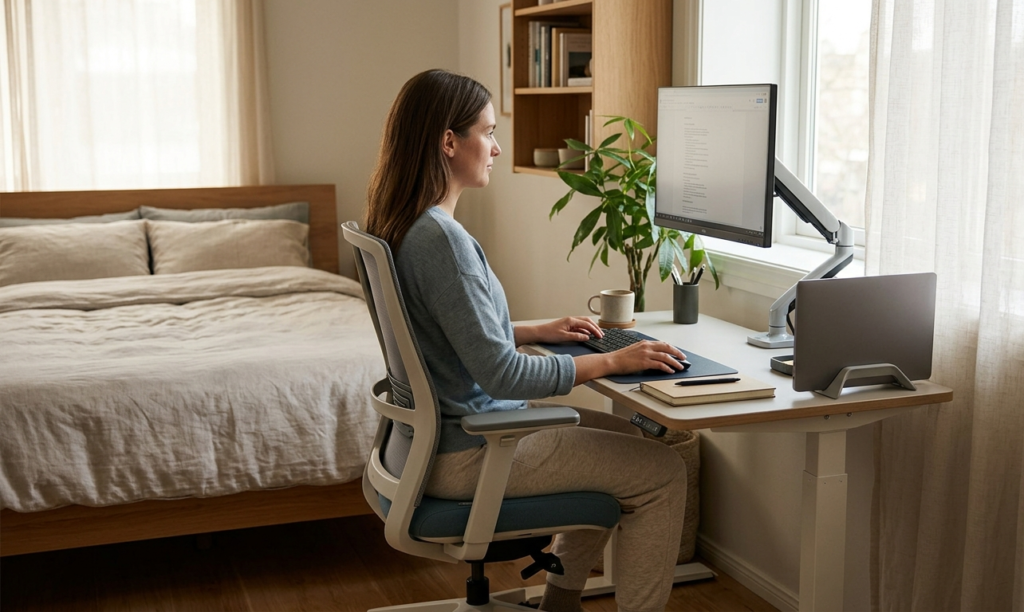
If space allows, avoid placing your desk directly facing your bed. Staring at your pillows all day can trigger a subconscious desire to nap, while seeing your monitor from your bed can make it harder to fall asleep. If you can, position your desk perpendicular to the bed or near a window. Facing a window provides natural light, which is essential for regulated circadian rhythms, making you feel more alert during the morning and tired when the sun goes down.
In very tight quarters, consider a “cloffice” (closet-office). By removing closet doors and installing a floating desk, you gain the ability to physically close the door on your workday. If that isn’t an option, a simple room divider or even a tall bookshelf can act as a partition, shielding your sleep space from the blue light and clutter of your tech.
Prioritizing Ergonomics in Small Spaces
In a bedroom, there is a temptation to work from the bed itself. While the “propped up with pillows” look appears cozy in photos, it is an ergonomic nightmare for your spine, neck, and wrists. The bed lacks the firm support needed for long-term sitting, leading to rounded shoulders and lower back fatigue.
To work comfortably, you need a stable surface and a chair designed for task-oriented sitting. Since bedrooms are often carpeted, consider a chair with high-quality casters or a chair mat to ensure you can move easily. Look for “apartment-sized” ergonomic chairs that offer lumbar support and adjustable armrests but have a smaller overall footprint so they don’t dominate the room.
The height of your monitor is the next critical factor. In a bedroom office, desks are often shallower than standard corporate desks. This brings the screen closer to your eyes. To prevent “tech neck,” your screen should be at eye level, and your elbows should be at a 90-degree angle while typing. Using a monitor arm or a riser can clear up valuable desk real estate while ensuring your posture remains upright.
Managing the “Multi-Use” Lighting
Lighting in a bedroom is usually designed for warmth and relaxation—think soft-white bulbs and shaded lamps. However, productive work requires cool, focused light to reduce eye strain and keep you focused.
The solution is layered lighting. Keep your warm bedside lamps for the evening, but invest in a dedicated LED desk lamp with adjustable color temperatures. During the day, set the desk lamp to a cooler, “daylight” setting (around 5000K). This mimics natural sunlight and helps combat the afternoon slump.
Be mindful of glare on your screen, especially if your desk is near a window. Use sheer curtains or adjustable blinds to diffuse harsh afternoon sun. If you find yourself in Zoom meetings regularly, a light that faces you can prevent you from appearing as a silhouette against the bedroom background, maintaining a professional look despite the casual setting.
Hidden Comfort: Cable and Clutter Control
Nothing ruins the zen-like atmosphere of a bedroom faster than a “spaghetti” of power strips and charging cables. Visual clutter is a known stressor that can impede both concentration and sleep.
To keep the space comfortable, use cable management trays that mount under the desk. This keeps wires off the floor, making it easier to vacuum and preventing the “office” from overflowing into the “bedroom.” Use a dedicated dock for your laptop and peripherals so that at the end of the day, you can unplug one cord and tuck the laptop away in a drawer.
Organizers are also vital. In a bedroom office, you likely don’t have room for a filing cabinet. Use vertical space with wall-mounted shelves or a small rolling cart that can be tucked into a corner. The less “stuff” that is visible on your desk surface, the more breathable and comfortable the room will feel.
Recommended Products
- SIHOO M57 Ergonomic Office Chair — Best for those who need full-day support in a bedroom office; the breathable mesh keeps you cool and the adjustable features ensure a custom fit without a massive footprint. View on Amazon
- Logitech Lift Vertical Ergonomic Mouse — Best for small to medium hands and tight desk spaces; the vertical design reduces wrist strain, and its quiet clicks won’t disturb a partner if you’re sharing the room. View on Amazon
- HUANUO Monitor Stand Riser — Best for clearing desk clutter; it raises your screen to eye level to prevent neck pain while providing storage space underneath for a keyboard or notebooks. View on Amazon
The Essential “Shutdown” Ritual
The final piece of the comfort puzzle isn’t physical—it’s psychological. When your office is in your bedroom, the workday never truly “ends” unless you create a ritual to close it.
Try a “visual reset” every evening. Clear your coffee mugs, close all tabs, and put your chair back in its place. Some people even throw a decorative cloth over their monitor or desk to physically hide the workspace at night. By removing the visual reminder of your to-do list, you allow your brain to enter “rest mode.”
Conclusion
Working in a bedroom office doesn’t have to be a compromise. By prioritizing a smart layout, investing in compact ergonomic tools, and managing your light and clutter, you can create a space that supports your career and your sleep. Comfort, in this case, is about balance: giving yourself the professional environment you need during the day while preserving the sanctuary you deserve at night. With the right setup, your bedroom can successfully serve as both a powerhouse of productivity and a peaceful place to recharge.